
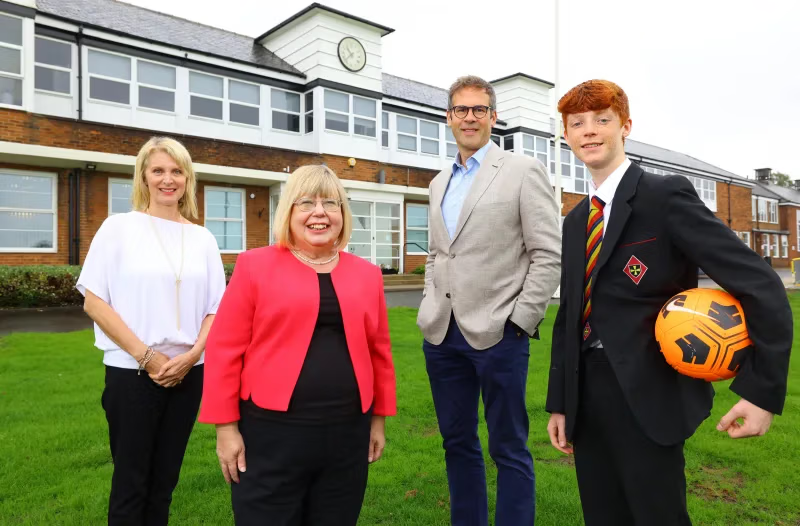
Above: (L-R) Marie Difalco. MP Liz Twist, Dame Allan’s Principal Mr Will Scott and pupil Marcus
Dame Allan’s Schools’ pioneering efforts to support its colour blind pupils have been praised by a North East mother who is campaigning to reintroduce routine in-school screening for one of the world’s most common inherited conditions.
To mark Colour Blind Awareness Day (SEPT 6), Marie Difalco, whose son Marcus has Colour Vision Deficiency (CVD), has spoken out about her crusade to ensure that the UK’s 450,000 schoolchildren affected by colour blindness are screened and supported during their education.
With the backing of Tyneside MP Liz Twist, Marie, from Ryton, is lobbying the government for changes in legislation after routine school screening for colour blindness was scrapped in 2009. She has highlighted the steps being taken by Dame Allan’s Schools, where Marcus, 15, is a pupil, to screen every pupil for colour blindness and train staff to support those with CVD.
Overseen by the school nurse, Lynsey Procter, Dame Allan’s screens its pupils using the Ishihara test, the most well-known test for colour blindness, consisting of circular plates with colour dots depicting a number or pattern.
Alan Hopper, Vice Principal (academic) at Dame Allan’s Schools, in Fenham, said: “It’s vital that teachers are aware of the limitations of coloured labels, charts or codes used in textbooks or as teaching aids when there’s a colour blind child in the classroom. We are aware that without intervention a colour blind pupil will be at disadvantage right across the curriculum.”
Marie, an author on colour blindness and passionate activist, said: “Dame Allan’s are pioneering in this field when few others have any real understanding of the impact of colour blindness in education. They will be so far ahead when legislation changes and screening is brought back into schools.”
Marie realised Marcus was colour blind when, at six years old, he ran into the kitchen holding a green pen and an orange pen and asked his mum which of the pens was orange.
“It came as such a shock,” admitted Marie. “I was horrified that it hadn’t been picked up before, especially as he’d had the standard vision screening offered to all children in their first year at primary school. As a parent, I’d assumed they tested for all common eye conditions, but they don’t.”
Research by the Colour Blind Awareness organisation has shown that 80 per cent of Year 7 children have never been screened for CVD and at least 50 per cent of colour blind students are thought to be undiagnosed by the time they sit their GCSEs in Year 11.
As colour is extensively used as a teaching aid in schools, Marie believes colour blind children are put at a ‘serious disadvantage’ and face barriers in their education.
“Resources, books and exam papers can all discriminate against colour blind children if colour isn’t used in an accessible way,” she explained.
Marie’s fight for CVD screening to be re-established in schools has the backing of Blaydon MP Liz Twist. Ms Twist said: “Having heard the stories of how much this issue has impacted upon people’s lives I believe it is crucial to have a testing system that can help us build the most considerate environment we can.”
Ms Twist brought the debate to the House of Commons when considering, more specifically, access to sport for people with colour blindness. She has been working with Equalities Minister and Government Minister for Sport, Stuart Andrew, to discuss what more should be done to support colour blind people.
Earlier this year, Mr Andrew told MPs in the House of Commons of his own experience of colour blindness. “I remember being in school and having to draw a map of where we lived, and I coloured a river purple and got told off for doing so,” he said. “The world around us is often designed for people with standard colour vision, and that can make everyday tasks and activities much more difficult.”
Colour blindness affects 1 in 12 men (eight per cent) and 1 in 200 women. In the UK there are approximately three million colour blind people.
With no human cure for colour blindness, Marie admits she won’t stop advocating for change until ‘the world adapts’.
“We obviously don’t advocate for colour to be taken out of the classroom,” said Marie. “What we are saying is, you should always offer a secondary label or a differentiator to make things accessible for those with colour blindness.”
Marcus, 15, added: “My mum’s drive, and the fact my school helps me and other colour blind pupils, has meant I’ve never felt that my condition holds me back here. In an equal world it’s only fair that all young people with colour blindness can access that same level of support.”