
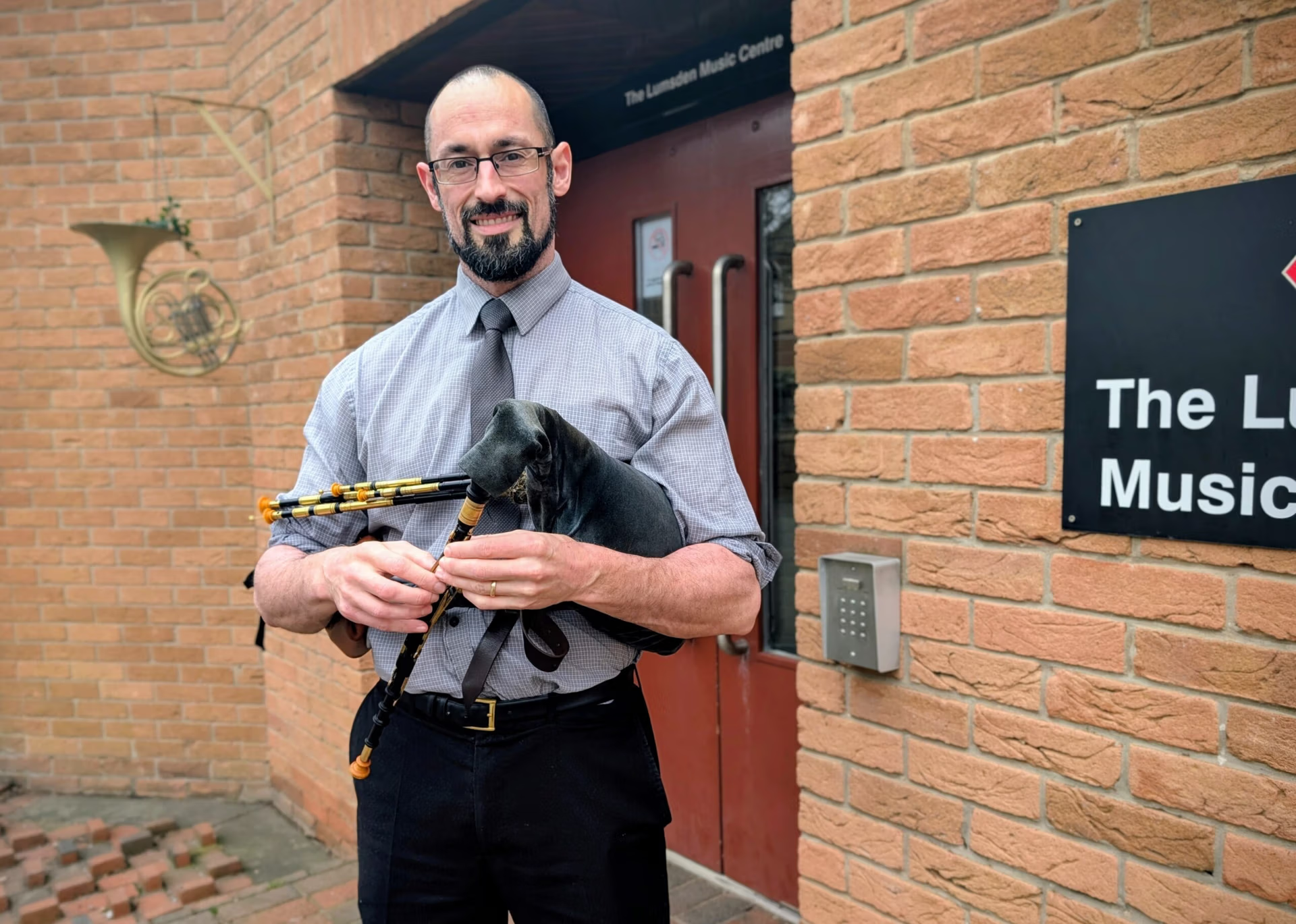
Dame Allan’s Schools’ Head of Latin, Andrew Lawrenson, is a highly respected Northumbrian smallpipes player – and one of a small number of musicians able to make the instrument himself. Through both his teaching and his musicianship, he brings precision, craft and cultural depth into school life.
By day, Andrew Lawrenson leads Latin at Dame Allan’s Schools. Beyond the classroom, he plays a quieter but no less distinctive role as a custodian of one of England’s oldest musical traditions: the Northumbrian smallpipes.
The pairing is less unusual than it might first appear. Both Latin and the pipes demand close attention to detail, discipline and a respect for tradition — qualities that shape Andrew’s approach to teaching as much as to music.
Originally from Scotland, Andrew studied Latin at school in St Andrews before reading English Literature and Latin at Newcastle University. After a brief spell in the civil service, he trained as a teacher in Glasgow and has taught almost continuously as a Latin specialist, including posts in Aberdeen, St Andrews and at Queen Elizabeth High School in Hexham. He is now in his third year as Head of Latin at Dame Allan’s.
For Andrew, Latin offers pupils something increasingly rare: immersion in a world far removed from the present day. “You step into a society with very different values, one where slavery and capital punishment were the norm,” he explains.
That distance encourages pupils to reflect critically on their own world while developing sophisticated language skills, analytical thinking and close reading – qualities that translate well beyond the classroom.
Music entered his life much earlier, sparked by a set of Northumbrian pipes that belonged to his father. Unlike the better-known Highland bagpipes, the Northumbrian smallpipes are bellows-blown rather than mouth-blown, producing a quieter, sweeter sound suited to indoor performance. They are also England’s only native bagpipes with an unbroken playing tradition.
Andrew was drawn to the instrument at a time when Northumbrian piping was enjoying a resurgence, with a new generation of players — including the widely recognised Kathryn Tickell — recording and performing. He began learning seriously under the guidance of experienced musicians, including Patricia Jennings, later Chair of the Northumbrian Pipers’ Society.
A strong tradition of learning by ear shaped his early development, alongside regular mentoring and competitive playing.
Today, Andrew is an established figure within the piping community. He is a committee member of the Northumbrian Pipers’ Society and is listed as a repairer and reed-maker — a highly specialised skill. He has also been invited to serve as Deputy Piper to the Duke of Northumberland, stepping into a ceremonial role that has existed for over 200 years and performing for visitors at Alnwick Castle and other official occasions.
Alongside playing, Andrew has gradually taught himself to make the pipes — a complex process involving woodwork, metalwork, reed-making and painstaking calibration. Very few musicians attempt it. “It’s intimidating,” he admits, “but I like understanding how things work.” One complete set he has made himself is the instrument he now plays.
At Dame Allan’s, Andrew shares this expertise through a co-curricular piping club, where around half a dozen pupils at varying stages learn the instrument. One pupil, Savile, has shown particular aptitude, quickly picking up tunes and developing strong musical instincts.
Whether through Latin or the pipes, Andrew’s work centres on continuity: passing on knowledge, preserving skills and encouraging pupils to look beyond the familiar. “It’s about immersion,” he says. “Taking the time to understand a different system — whether that’s an ancient language or a traditional instrument — and learning to think with care and precision.”