
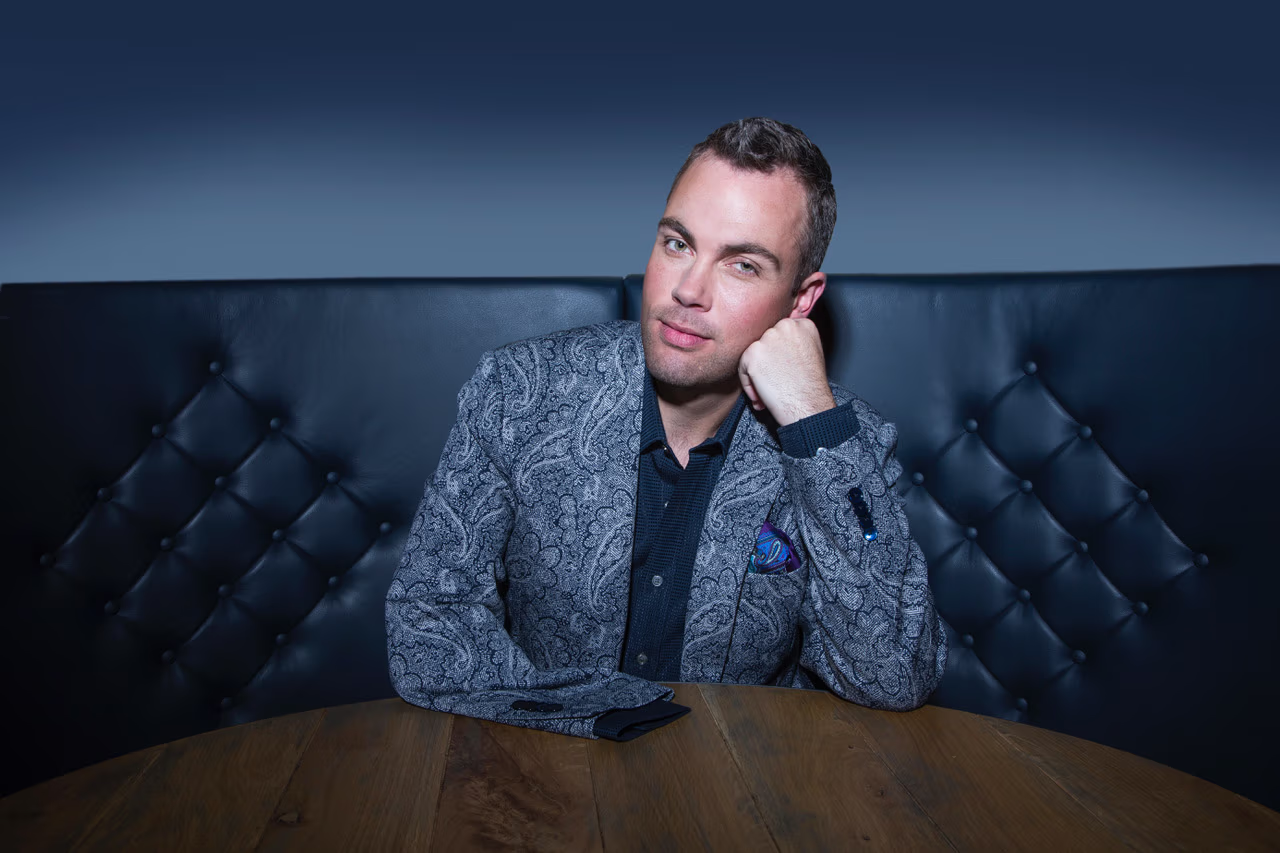
Born without his right hand, concert pianist Nicholas McCarthy has built an extraordinary international career, redefining what is possible through resilience and self-belief. Ahead of his visit to Dame Allan’s Schools on Thursday (26 March), he reflects on the moment that changed his life, the setbacks that shaped his journey and the message he hopes will inspire pupils long after his performance.
When Nicholas McCarthy sits down at the piano in the Newsom Hall on Thursday, the audience will undoubtedly be struck first by what makes him different. But it’s what follows – rich, expressive playing that seems to defy the limitations of one hand – that will leave the deeper impression.
Pupils, parents and staff at Dame Allan’s will have the opportunity to hear not only his extraordinary musicality but the story behind it, as he visits as part of the school’s lecture series – an initiative designed to broaden horizons and inspire ambition.
For Nicholas, the journey began not in a conservatoire or a musical household, but in a school assembly.
“I describe it as my Oprah Winfrey moment,” he recalls. “I was 14, sitting in assembly, listening to a friend play a Beethoven sonata. I’d heard the names – Beethoven, Mozart – but I’d never really connected with it. And then suddenly, everything clicked. I had this overwhelming feeling that I was put on this earth to play music and communicate with people – and that the piano was how I was going to do it.”
There was, however, one obvious challenge. Nicholas was born without his right hand.
“At 14, you don’t think about those things,” he laughs. “The world feels completely possible. It didn’t even cross my mind that it might be an issue.”
That moment set in motion a journey that has since taken him to the top of the classical music world.
Remarkably, he did not begin playing the piano until that point—an age when many musicians are already years into formal training.
Armed with a modest keyboard and curiosity, he taught himself by ear, absorbing everything he could. “I became a sponge,” he says. “I wanted to know what I liked, what I didn’t like – I just wanted to understand this whole world of classical music.”
Support from home proved pivotal. One early memory still stands out.
“My dad shouted upstairs, ‘Turn the radio down.’ And I shouted back, ‘It’s not the radio – it’s me!’ he smiles. “What a compliment… he thought I sounded like a professional recording!”
Soon after, his parents encouraged him to take lessons, recognising a talent that was beginning to take shape. But the path ahead was far from straightforward.
As his ambitions grew, so too did the challenges. A particularly difficult setback came when a music school dismissed his application outright.
“I was told there was no point—they couldn’t understand why I’d even want to play the piano given my disability,” he says. “At that moment, I felt like my dream had been taken away before it had even started. It was very wounding.”
For weeks, he stopped playing altogether. But then came a turning point.
“I thought, why am I allowing one person – out of billions – not even hearing me play, to stop me?” he says. “I had to have a word with myself. I realised that if I wanted this, I had to keep going.”
That decision would prove transformative. He auditioned at the Guildhall School of Music and secured a place, on the condition that he specialised in a little-known area: left-hand repertoire.
What he discovered, Nicholas explained, was not a limitation, but an entire musical tradition rooted in history.
Following the First World War, Austrian pianist Paul Wittgenstein, who lost his right arm in combat, commissioned leading composers to write works for the left hand alone. The result was a rich body of repertoire that would ultimately shape Nicholas’ career.
“Without that, I wouldn’t have access to so much incredible music,” he explains. “It completely changed what was possible.”
Since graduating from the Royal College of Music as its first one-handed pianist, Nicholas has built an international career, performing at leading venues and challenging perceptions of what musicianship looks like.
One recent moment stands out above all.
“Walking onto the stage at the Royal Albert Hall for the BBC Proms – it was everything I’d worked towards,” he says. It wasn’t just a performance; it was a real turning point.”
The impact was immediate, opening doors to further opportunities – some of which he will share when he visits Dame Allan’s.
While his achievements are remarkable, it is Nicholas’ message that he hopes will resonate most powerfully with the Dame Allan’s audience.
“I doubt many people in the audience will want to become concert pianists,” he reflects. “But I hope my story shows that whatever your goal is, the path won’t be straightforward – and that’s okay.”
Central to that message is resilience.
“Life isn’t linear. You will face knockbacks – whether it’s not getting a place, not getting a job, or something not working out the way you hoped,” he continues. “What matters is how you respond. You pick yourself up, brush yourself down and move on to the next thing.”
It is a lesson drawn not just from success, but from the setbacks that shaped him.
“I hope that, at some point in their lives, pupils will remember my story,” he adds. “And that it helps them find the strength to keep going.”
Dame Allan’s Schools, pupils (Y6 and above), parents, staff and Allanians are welcome to attend this lecture. Free tickets can be booked here.
Nicholas will also be performing at the Glasshouse at Gateshead on Sunday April 12th at 3pm