
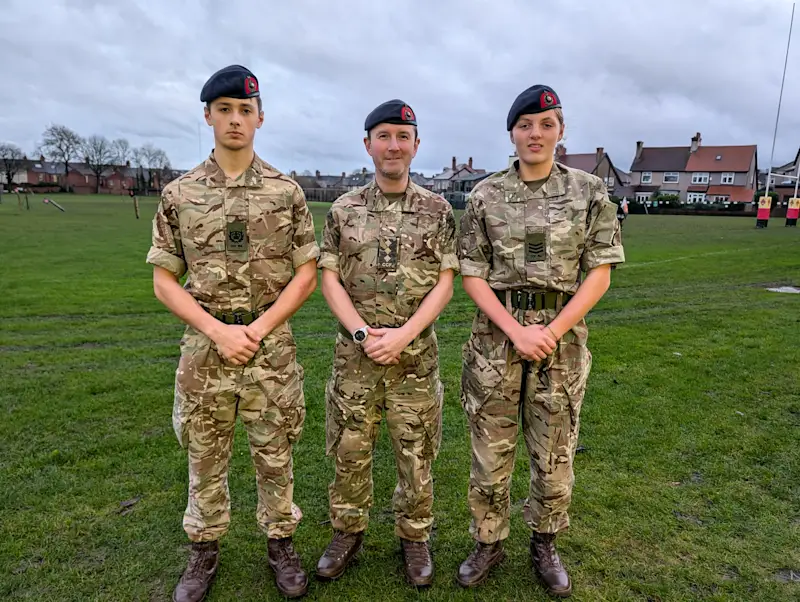
Above: Dame Allan’s CCF Contingent Commander and Chemistry teacher Owain Jones (centre) flanked by pupils Milo (L) and India (R)
Every Tuesday afternoon, when many pupils are packing up to head home, a group of committed Dame Allan’s pupils meet for their weekly parade. Uniforms are inspected, boots polished and berets shaped with care. The atmosphere is focused but warm — unified, purposeful and proud — reflecting the ethos at the heart of the Royal Marines Combined Cadet Force (CCF) at Dame Allan’s: self-reliance, discipline, teamwork and cheerful determination in adversity.
At the heart of it is Owain Jones — Chemistry teacher, outdoor enthusiast and now Contingent Commander of the Royal Marines section. Captain Jones first joined as a Cadet Force Adult Volunteer (CFAV), gradually taking on more responsibility before applying formally for the Contingent Commander role. Today, he fully embodies the values he instils in his cadets.
“I’ve always loved the outdoors,” he says. “When I was younger, we were out in all weathers — boots on, get up a hill, crack on. It teaches you that challenge isn’t something to shy away from. You learn that you can cope, even when things aren’t perfect.” It’s this idea of steady, practical resilience — not discomfort for its own sake — that Capt. Jones threads through the programme.
Dame Allan’s is one of only a handful of schools in the country to host a Royal Marines-affiliated CCF section, something Capt. Jones sees as both a privilege and a responsibility. “Royal Marine Commandos are the world’s best light infantry,” he says. “There’s a pride in wearing that cap badge. You feel part of something elite — but you also have to live up to it.”
Cadets join in Year 9 and begin a two-year programme rooted in core Marines skills but broadened for teenagers: fieldcraft and campcraft, navigation and map-reading, camouflage and concealment, patrolling, rigorous weapons-safety instruction, leadership and communication. “They’re learning practical skills,” Capt. Jones says, “but the real development is internal — confidence, decision-making, teamwork.”
Older cadets in Years 11–13 take on leadership roles, supporting lessons, mentoring younger recruits and applying the skills they’ve learned. “We see quiet pupils grow into confident leaders,” Capt. Jones says. “It’s not about rank or ego — it’s about what each person brings to the team. That’s a powerful thing for teenagers to experience.”
The programme is shaped by the Royal Marines values — Excellence, Integrity, Self-Discipline and Humility. Alongside them sits the Commando Spirit: Courage, Determination, Unselfishness and Cheerfulness in adversity. “These values spill into everything they do,” he says. “Cadets learn to persevere when they’re tired. They learn to help someone who’s struggling. They learn that it’s OK to make mistakes — you keep trying.”
Capt. Jones has seen many transformations. Some pupils join with TV- and film-inspired expectations — fascinated by the idea of adventure, kit and the outdoors — but without yet understanding the discipline, teamwork and leadership that sit behind it. As they progress through the ranks, they develop into calm, capable leaders with strong communication skills, immaculate uniforms and a natural ability to guide younger cadets. “That’s the CCF effect,” he says. “You watch them grow into themselves.”
National research reflects this pattern: cadet programmes significantly boost confidence, resilience, teamwork, behaviour and academic engagement. For some pupils, it is genuinely life-changing.
Training extends well beyond the classroom. This year, Dame Allan’s secured permission to train on the Town Moor, giving pupils space to practise navigation, pacing, camouflage and fieldcraft in a realistic outdoor environment. Outdoor education is woven throughout, thanks to Capt. Jones’s own background in mountain walking, wild camping and expedition skills.
“They learn to look after themselves,” he says. “How to stay warm at night, how to keep kit dry, how to think ahead. We guide and support, but ultimately, they learn independence.”
There are annual field days, a four-day training camp in March, competitions and plans for an ambitious new amphibious assault day involving boats, beach landings and reconnaissance exercises.
In October, Dame Allan’s achieved its best-ever result in the Sir Steuart Pringle Trophy, taking third place in the Normandy Tier. The Pringle Trophy is the premier national competition for Royal Marines CCF units, testing navigation, tactics, physical robustness, teamwork and problem-solving. Schools such as Harrow, Charterhouse, Rugby and Malvern competed. “To come away with a trophy among those names is huge,” Capt. Jones says. “The cadets showed real resilience, humour and determination. They were brilliant.”
Year 10 pupil India, who captained the team, received the Commando Spirit Medal for outstanding leadership and cheerfulness under pressure. “She’s one of our rising stars,” he says. “So is Milo, our new Warrant Officer, and we’ve got more coming through. The future is incredibly bright.”
Because the Royal Marines CCF sits under the Royal Navy, Dame Allan’s cadets can access an exceptional range of MOD-funded courses — including sailing, powerboating, first aid qualifications, mountain and adventure training, canoeing, kayaking, bushcraft and survival skills. “Some of these courses cost hundreds in the civilian world,” Capt. Jones says. “For cadets, it might be £30. They walk away with nationally recognised qualifications.”
Several former cadets have gone on to military pathways, including Sandhurst and university officer training. But Capt. Jones is clear: the programme is not about military recruitment. “Most won’t go into the Forces — and that’s completely fine. Dame Allan’s Royal Marines CCF is not about producing future soldiers. It’s about producing capable young adults.”
This resonates with national findings too: over two-thirds of cadets say the programme improves their leadership skills.
Perhaps the most powerful aspect of the Marines CCF is the sense of community it creates. “We have our black-tie contingent dinner in the Newsom Hall,” Capt. Jones says. “Proper etiquette, formal speeches, awards, promotions… It teaches them how to conduct themselves in an adult environment. And they love it.”
It’s a diverse group — boys and girls, quiet and loud, academic and sporty. “Everyone supports each other,” he adds. “If someone’s having a flat moment, someone else will put an arm around them and say, ‘Come on.’ That supportive push — that’s the culture we want.”
For Capt. Jones, the purpose is simple. “The skills they learn — resilience, confidence, teamwork, self-discipline — they can take anywhere,” he says. “School, university, work, life. These are skills that stay with them.
“If CCF had existed at my school, I’d have jumped at the opportunity. You’d be mad not to.”