
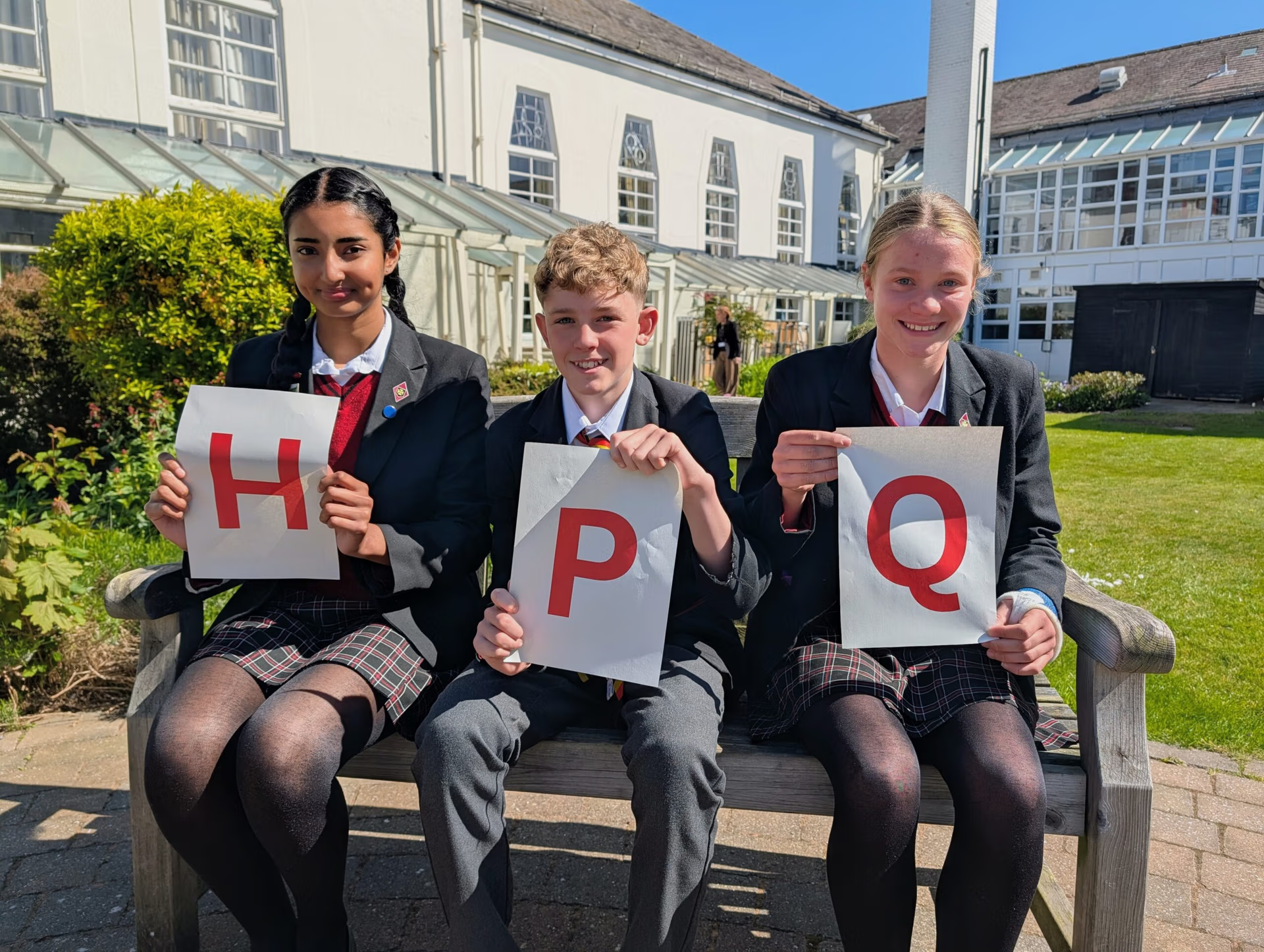
Dame Allan’s Schools has introduced the Higher Project Qualification (HPQ) for Year 9 pupils—thought to be among only a small number of schools in the North East to do so—broadening its academic offer and encouraging independent learning from an earlier stage.
The Level 2 qualification is designed to develop independent learning, research skills and intellectual curiosity. Launched in February, it sits alongside GCSE study as a complementary, skills-based qualification. While equivalent to half a GCSE, it differs significantly in approach, placing emphasis on autonomy, critical thinking and project management rather than examinations.
Dr Wilkinson, Head of Religious & Philosophical Studies and lead for the HPQ, explains: “The HPQ is entirely coursework-based. Pupils choose a topic that really interests them – not something they cover in the curriculum – and develop it into a substantial project over the course of a year.
“They’re responsible for coming up with their own title, planning the entire project, managing their time, finding and evaluating sources, delivering the final outcome and then evaluating both the project and their own performance.”
Pupils can produce a written report of around 2,000 words or create an artefact, supported by a research-informed written analysis evaluating the outcome against criteria they define. All present their work, with projects completed by the Spring term of Year 10—before the bulk of GCSE coursework begins.
A defining feature of the HPQ is the freedom it offers. For William SB, his project—creating a website to promote and manage his car washing business—builds on a venture he began over the summer holidays.
“I set up a car wash service, knocking on doors and building up my customer base,” he says. “Over the course of eight weeks, I secured about 50 customers. When I learned about the HPQ, I thought it was the ideal opportunity to take it further by building my own website.”
“I’m learning how to manage my time, balancing school work, my business and building the website. I’m also learning coding, videography and website design—skills I wouldn’t usually learn in lessons.”
Across the cohort, projects reflect a broad range of interests. Amira C’s project explores the rise of myopia in younger generations and its links to lifestyle and technology. She says: “It’s helping me develop skills in research, critical thinking and organisation, and giving me more confidence in working independently.”
Katie W’s project—How has psychology influenced sport?—examines the role of mental performance in athletics. “HPQ is helping me understand how to use information properly and keep track of my research,” she says. “The biggest challenge has been narrowing down my focus and balancing it with other commitments.”
The decision to introduce the HPQ in Year 9 is deliberate. “We’ve got some very able Year 9 pupils,” says Dr Wilkinson. “Introducing it at this stage means they can start their GCSE courses with a much stronger foundation.”
Pupils complete around 30 hours of taught skills, including research methods, source evaluation, referencing and project planning. “They’re learning how to evaluate sources critically and build a bibliography—skills that will support them through their GCSEs and beyond,” Dr Wilkinson explains.
The HPQ also develops broader learning habits. “Time management is a massive one,” she adds. “They’re learning how to juggle commitments and find strategies that work for them.”
She also highlights the importance of questioning information: “Being able to evaluate what they read and where it comes from is incredibly important.”
Pupils are introduced to responsible research practices, including avoiding plagiarism and using AI appropriately, and are encouraged to reflect on their work. “They have to produce something that is genuinely polished, often through redrafting,” says Dr Wilkinson. “At the end, they evaluate not just the project but their own performance.”
While independence is central to the qualification, pupils are supported throughout by staff acting as supervisors. Their role is carefully balanced to ensure pupils retain ownership of their work.
“We describe ourselves as ‘guides on the side’ rather than directing the process,” explains Dr Wilkinson. “Pupils need to be autonomous and independent.”
Interest in the HPQ has been strong in its first year, with more than 30 pupils taking part following an application process designed to ensure commitment. The cohort reflects the school’s fully co-educational environment, with an even balance of boys and girls.
“It’s a really nice mix,” says Dr Wilkinson. “They’re working together after school, and it’s been great to see how comfortable they are in each other’s company.”
The introduction of the HPQ builds on Dame Allan’s existing academic provision, including the Extended Project Qualification (EPQ) in the sixth form.
English teacher and Head of Academic Aspiration and EPQ, Ms Salisbury says: “We have long seen the benefits of the EPQ with our sixth formers, as it helps them to develop curiosity, initiative and resilience for independent learning. The HPQ will undoubtedly bring the same benefits to our younger pupils, as well as establish a solid foundation in research skills that will allow them to tackle the EPQ with greater confidence in the future.”
Dr Wilkinson adds: “It’s about broadening the provision and allowing pupils to be autonomous academic learners—to really take ownership of something they want to explore.”
Looking ahead, the focus is on long-term impact. “One of the most important outcomes will be that sense of achievement,” she says. “Being able to say, ‘I’ve done this, I’ve managed it, and I know how I could do it even better next time.’”