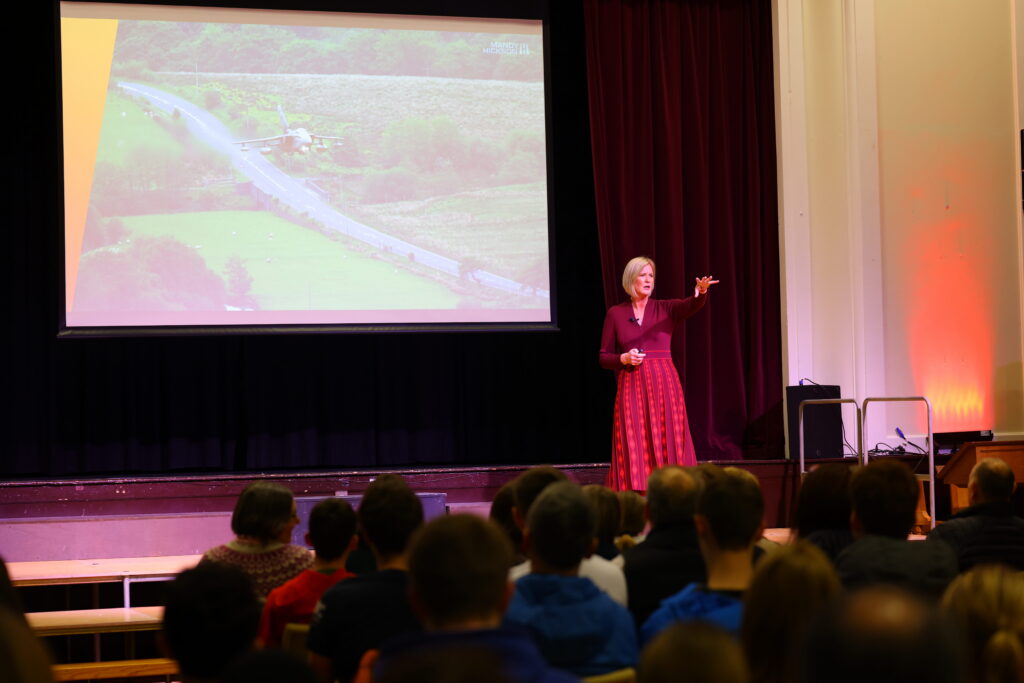
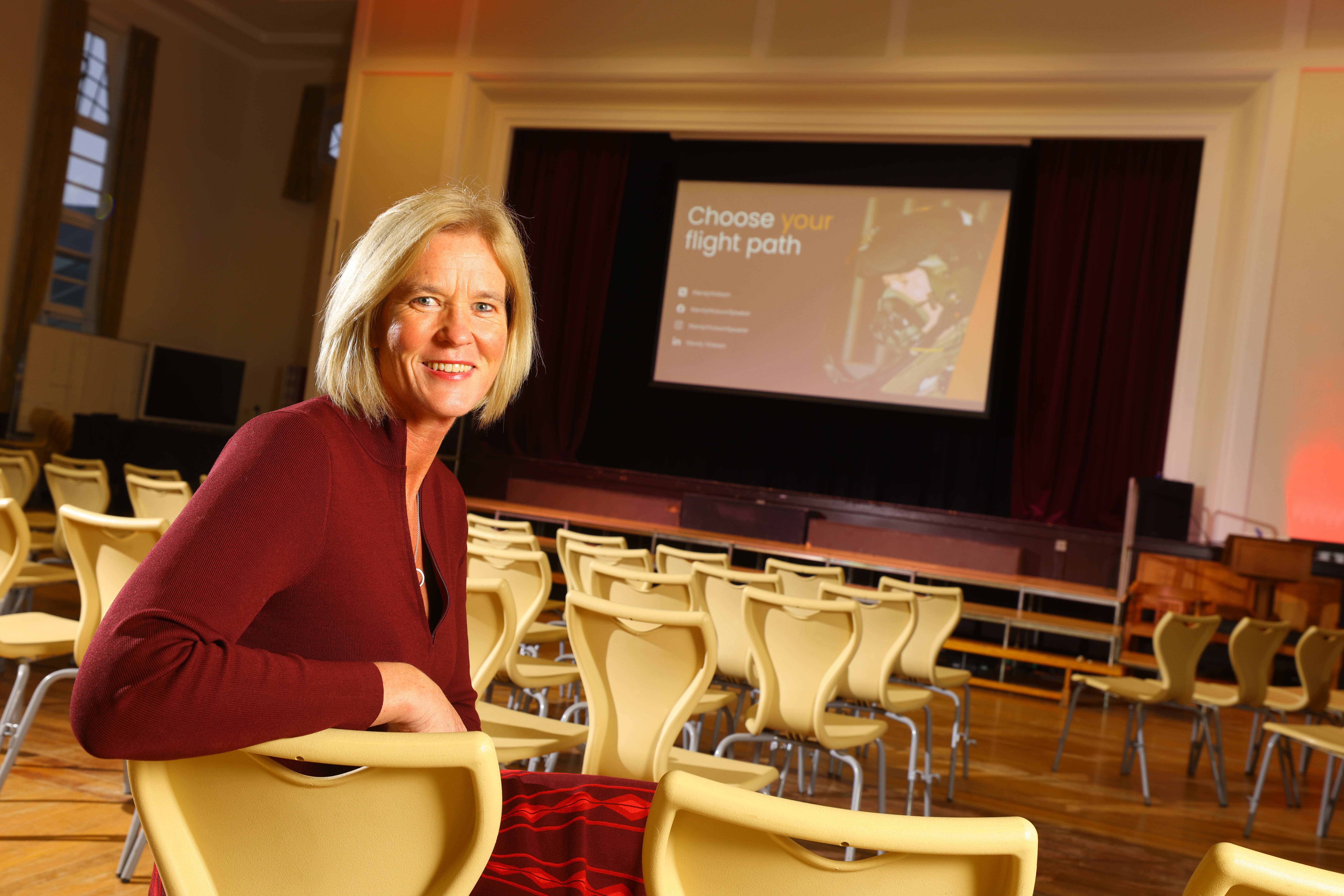
Former RAF fast jet pilot Mandy Hickson delivered a powerful and uncompromising message to pupils at Dame Allan’s Schools as the latest speaker in The Lectures series — drawing on combat missions over Iraq, personal setbacks and life on a male-dominated squadron to challenge young people to rethink fear, failure and what they believe is possible.
Mandy Hickson’s career is remarkable in any measure: the first female pilot to fly the Tornado GR4 on frontline operations, three tours of duty, 45 missions over Iraq and later a role as her squadron’s Combat Survival and Rescue Officer. But for those listening in the audience of Dame Allan’s pupils, what made her lecture unforgettable was the way she linked her extraordinary achievements to lessons about life and personal growth.
She was candid about her path into the RAF, which was far from seamless. Early in her career, she experienced failure. “I didn’t pass the pilot aptitude tests the first time,” she told pupils. “I was devastated. I thought that was it. Dream over.” Rather than walking away, she recalibrated, joining the RAF as an air traffic controller before reapplying and securing pilot training. The setback, she explained, forced her to develop resilience sooner than she might otherwise have done.
As one of the very few women in a newly opened fast jet environment, Mandy Hickson stepped into a culture not designed with her in mind. At six foot tall and the lone female in her squadron, she earned the call sign Big Bird, navigating not just complex aircraft but casual misogyny and the constant pressure of being a pioneer.
Reflecting on that period, she told pupils: “I thought, ‘I’ve done it, I’ve broken the system.’ And then they said, we are taking you on as a test case. We’d like to find out how far someone with no aptitude can get before they fail.
“That planted a big seed of doubt — a psychological barrier that stayed with me for years.”
That doubt would be tested repeatedly.
During training she faced one of the RAF’s most unforgiving assessments: the “chop ride”, a make-or-break flight where failure meant immediate removal from the programme. Three trips from graduating, she had already failed once. The margin for error had vanished.
She recalled: “I was three trips away from graduating, and I failed a flight. But never mind, you failed in the past, do it again. I failed it again, and now I’m in this spiral of loss of confidence because I was then being put up for something called a chop ride. If I fail this flight, I am leaving the Air Force. Four years, £2.5 million spent on my training to this point, and they will get rid of you if you do not upgrade. That is how harsh it is.”
The night before the chop ride, her squadron stepped in. They ran her through mock exercises, shared expertise and went out of their way to prepare her. Their support proved decisive. With their help, she completed the chop ride and secured a coveted place on the next course.
For Mandy Hickson, it crystallised one of the most important lessons of her career: no one succeeds alone.
“One of your course mates has jeopardised his career advancement to get you through,” she told pupils. “That’s what leadership and teamwork are. That’s unselfish behaviour — helping someone else succeed, even when it comes at a cost to you.”
It was a theme that ran throughout her talk. Behind every fast-jet pilot, she explained, is an enormous team.
“They say it takes 2,000 people to launch one aeroplane on the front line,” she said. “The trust has got to be there at every single stage.”
Her message on failure extended well beyond flying.
“If we fail, but we’ve got a purpose, then we will just do it again,” she said. “It’s about putting ourselves out of our comfort zone sometimes, and then failing. And that’s okay. Learn really quickly, don’t dwell on it and move on. That’s how we build up that power bank of resilience.”
She also spoke openly about imposter syndrome — the quiet voice that questions whether you belong, even when you are sitting in the cockpit of a multimillion-pound aircraft.
“There were moments I thought, ‘What am I doing here?’” she admitted. “But you know what, everyone else is thinking the same thing at some point.”
For pupils, it was a reminder that even someone trusted with combat missions at 30,000 feet has moments of doubt.
Since leaving the RAF, Mandy Hickson has channelled those lessons into a new chapter. She is now a leadership consultant and the author of two books – An Officer, Not a Gentleman and An Officer and Her Gentleman – sharing the realities of her journey from cadet to combat pilot and the resilience she built along the way.
Through her speaking work, she helps organisations and young people understand that courage is rarely about fearlessness. It’s about making decisions under pressure, relying on your team and backing yourself when things go wrong.
Principal Will Scott, who attended the lecture, said Mandy’s message resonated far beyond aviation or the military. “She spoke with such honesty about the moments that didn’t go to plan as well as the moments of success,” he said. “What our pupils heard was not just the story of an exceptional pilot, but of someone who kept going when things were difficult.
“Her message was simple: setbacks are not the end of the story. Failure is information, confidence is built, not gifted, and the difference between those who succeed and those who stop often comes down to one thing — the willingness to try again.”